
Mise-en-scène of Spirited Away
- The Contemporary Curators
- Feb 21, 2021
- 3 min read
Updated: Mar 28, 2021
To construct the virtual medium into a "real world", Miyazaki's team of three hundred employees spent two to three years creating Spirited Away. More than 160,000 sheets of under drawings and nearly 1500 shots were presented for the perfection of Spirited Away. Because Miyazaki insists on hand painting rather than computer editing, therefore every frame in the film runs smoothly and realistically.
“Anime may depict fictional worlds, but I nonetheless believe that at its core it must have a certain realism. Even if the world depicted is a lie, the trick is to make it seem as real as possible. Stated another way, the animator must fabricate a lie that seems so real, audiences will think the world depicted might possibly exist.” ——Hayao Miyazaki
This nifty bit of animation by Miyazaki has been praised for its masterful handling of various themes, emotions, and social issues. The themes and emotions of Spirited Away have been emphasized through the use of color as well as Joe Hisaishi's music. The themes of Shinto (spirituality), environmentalism, capital greed have been emphasized and mentioned repeatedly.
Use of Color
The use of color was greatly emphasized throughout the film. In Studio Ghibli, Hayao Miyazaki and Hirokatsu Kihara always emphasized the use of color matching in creating meaning. To take the scene when Chihiro is escaping before nightfall, the color of the film transitioned from calming colors of the day to the fluorescent lights at night.
The warm, calming colors is often used in scenes associated with innocent and childlike moments. In Contrast with this is the bright, fluorescent, artificial light used in the bathhouse, the bathhouse is where Chihiro encountered the greed (something bad) possessed by almost all workers and the main antagonist- Yubaba. The use of different hues and saturations of colors serve as a purpose to introduce the characters and the audience in different scenes. Besides, the shifting from warm colors to bright, aggressive colors generated two spheres mentioned above: nature and calmness versus capitalistic chaos and greed.
1. Warm (up) Vs Bright (Down)


2. Warm (up) Vs Bright (Down)


3. Warm (up) Vs Bright (Down)


Use of calmness
Spirited Away is filled with moments of calmness that helped developed the atmosphere of daytime scenes in the film. The creation of simplicity and peace in which ample noise is more notable to the audience. There are three scenes uses this technique.
“We have a word for that in Japanese. It’s called ma. Emptiness. It’s there intentionally. [claps his hands] The time in between my clapping is ma. If you just have non-stop action with no breathing space at all, it’s just busyness. but if you take a moment, then the tension building in the film can grow into a wider dimension…. What my friends and I have been trying to do since the 1970’s is to try and quiet things down a little bit; don’t just bombard them with noise and distraction. And to follow the path of children’s emotions and feelings as we make a film. If you stay true to joy and astonishment and empathy you don’t have to have violence and you don’t have to have action. They’ll follow you. This is our principle.”——Hayao Miyazaki
This scene uses the techniques of calmness as the water surrounding Chihiro separates her from the noisy chaotic bathhouse. The purpose of using calmness here is to contrast Chihiro's nature with the bathhouse, calm vs chaos.
The use of calmness in this scene is definitely when Chihiro recalling her childhood memories of falling into the river. The use of calmness here also associates with the flying and memorizing process, both required a quiet and calm environment.
This scene was overlaid with the calming piano music, there is almost no sound emitted by the characters. The lack of dialogue in this scene has been explained at the cinematography analysis. The use of calmness was perfectly used by Miyazaki.
Common Camera Techniques
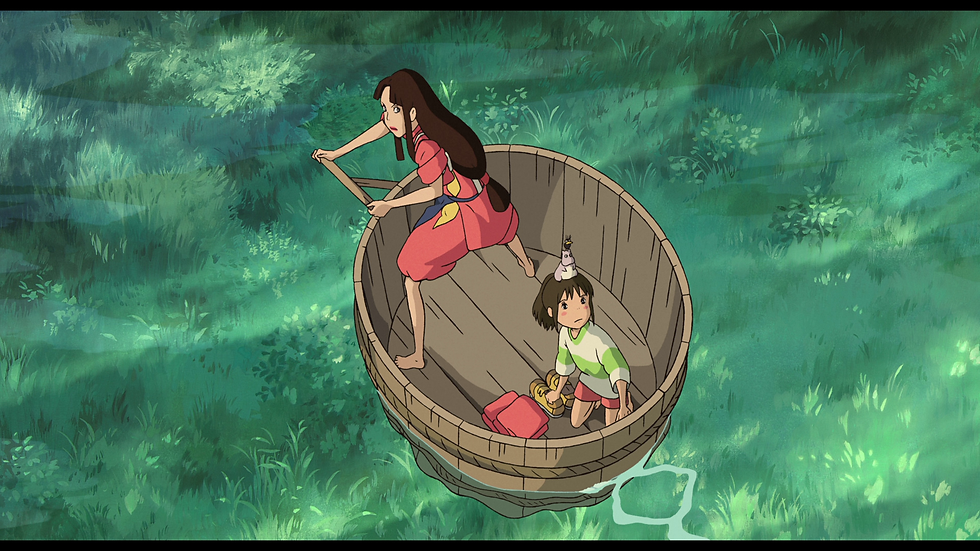
Spirited Away has used nearly 1500 shots that are considered common camera techniques. Different shots of surroundings from a high and far view, the close-up shot of character's faces to observe emotions, and also the objects to obscure characters all are the common camera techniques. This proves that animation starting to use techniques we have seen in the physical movies.
Spirited Away included a good deal of cinematography scene that provides the audience a component of depth and directed vision. Considering the origin of movies, it is safe to say that cinema and animation have become closer than ever. Though there are still distinction between both, but animations no longer employs fixed distance will be slowly infused with traditional cinema.
Written by Sean and Shu Han
(757 words)

Comments